
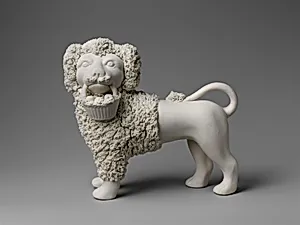
Standing poodle
Medium
Parian porcelain
Dimensions
8 1/2 x 9 x 4 3/8 in. (21.6 x 22.9 x 11.1 cm)
Classification
Figure
Culture
American
Department
The American Wing
Museum
Metropolitan Museum of Art, New York, NY
Credit
Gift of Dr. Charles W. Green, 1948
Accession Number
48.25.2
Rights
Public Domain
Tags
Art Historical Context
Step into the elegant world of mid-19th-century American ceramics with *Standing Poodle*, a charming figurine crafted by the United States Pottery Company of Bennington, Vermont, between 1849 and 1858. This piece exemplifies the company's foray into Parian porcelain, an unglazed, matte-white ceramic that mimicked the translucent glow of Parian marble from the Greek island of Paros. Popular in both Europe and America, Parian allowed factories to produce affordable, high-style sculptures for middle-class homes, bridging fine art and everyday decoration. Measuring 8½ x 9 x 4⅜ inches, this poised poodle captures the Victorian fascination with dogs as beloved companions and status symbols. Poodles, with their curly coats and aristocratic air, were especially trendy among the elite, making such figurines coveted mantelpiece ornaments. The United States Pottery Company's technical prowess shines in the crisp modeling and subtle detailing, showcasing America's growing industrial ambition to rival European porcelain makers like those in Staffordshire or Sèvres. Housed in The American Wing of The Metropolitan Museum of Art—thanks to a 1948 gift from Dr. Charles W. Green—this delightful work highlights the cultural role of animal sculptures in 19th-century domestic life, blending whimsy with refined craftsmanship.