
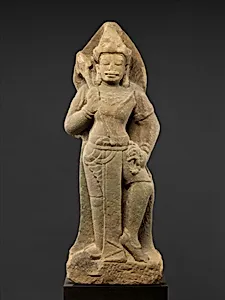
Standing Shiva or Temple Guardian (Dvarapala)
Unknown Artist
ca. first half of the 10th century
Medium
Stone
Dimensions
H. 50 1/2 in. (128.3 cm)
Classification
Sculpture
Culture
Vietnam (Champa)
Department
Asian Art
Museum
Metropolitan Museum of Art, New York, NY
Credit
Gift of R. H. Ellsworth Ltd., in honor of Douglas Dillon, 1987
Accession Number
1987.478
Rights
Public Domain
Tags
Art Historical Context
This imposing stone sculpture, titled *Standing Shiva or Temple GuardianDvarapala)*, hails from the Champa kingdom in ancient Vietnam, dating to the first half of the 10th century Standing over 50 inches tall, it exemplifies the robust stone carving traditions of Cham artisans, who drew heavily from Indian Hindu iconography. Champa, a coastal realm flourishing from the 2nd to 19th centuries, blended local motifs with Shaivite devotion, producing temple art that bridged Southeast Asia and the Indian subcontinent. As a *dvarapala*—a fierce door guardian meant to ward off evil spirits—this figure likely flanked the entrance to a brick temple sanctuary, such as those at My Son or Tra Kieu. Its identification as Shiva underscores the deity's prominence in Cham worship, where he was revered as both destroyer and protector. The sculpture's sturdy, muscular form and probable attributes like a trident or snarling expression highlight the dynamic tension in Cham sculpture, carved from durable sandstone to endure tropical climates and ritual use. A gift to the Metropolitan Museum of Art in 1987, this piece offers a window into Champa's golden age of religious architecture, inviting us to imagine the incense-filled temples it once defended. Its timeless presence reminds visitors of Hinduism's far-reaching cultural voyage.