
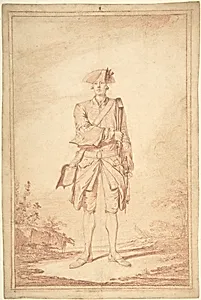
Standing Soldier: Garde Française
18th century
Medium
Red chalk over traces of graphite
Dimensions
9 7/16 x 6 5/16 in. (24 x 16 cm)
Classification
Drawings
Department
Drawings and Prints
Museum
Metropolitan Museum of Art, New York, NY
Credit
Bequest of Harry G. Sperling, 1971
Accession Number
1975.131.132
Rights
Public Domain
Tags
About this artwork
This drawing depicts a standing soldier of the Garde Française, the elite royal infantry regiment that served as the French monarchy's household troops. Created in the eighteenth century, the work was attributed to Antoine Watteau until 1983, when scholars reassigned it to Charles Dominique Joseph Eisen based on stylistic comparison with similar studies of French guardsmen. The drawing served as a study for an engraving that appeared as an illustration in "Positions des soldats de l'infanterie p...
Art Historical Context
In the elegant simplicity of red chalk over faint graphite traces, *Standing Soldier: Garde Française* captures a poised member of France's elite royal infantry, the Garde Française—household troops symbolizing the monarchy's power and prestige. Created in the 18th century by Dominique Joseph Eisen (1720–1778), this 9 7/16 x 6 5/16-inch drawing was once attributed to the Rococo master Antoine Watteau until scholars reassigned it in 1983, based on stylistic matches with Eisen's other guardsmen studies. Eisen, a Valenciennes-born painter and engraver famed for book illustrations, blended artistry with precision in works like this. This piece served as a preparatory study for an engraving in the 1751–1752 Paris military manual *Positions des soldats de l'infanterie pendant la manoeuvre du fusil*, standardizing rifle maneuvers for infantry. It reflects the Enlightenment's drive to document knowledge visually, preserving uniforms and postures for artists, historians, and soldiers alike. The Garde Française's ornate attire—evident in the drawing's meticulous shading—embodied martial splendor amid France's evolving military culture. Eisen's technique highlights 18th-century drawing's dual role: honing observational skills while fueling practical publications. A testament to art's intersection with discipline and documentation, this work invites us to admire the soldier's stoic grace and the era's quest for order.