
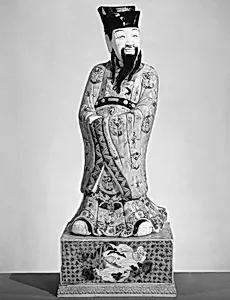
Standing Taoist God
Unknown Artist
late 17th–early 18th century
Medium
Porcelain with five-color biscuit on green ground
Dimensions
Overall: H. 21 3/4 in. (55.2 cm)
Classification
Ceramics
Culture & Period
China · late Ming (1368–1644)– early Qing (1644–1911 dynasty
Department
Asian Art
Museum
Metropolitan Museum of Art, New York, NY
Credit
Bequest of John D. Rockefeller Jr., 1960
Accession Number
61.200.37a, b
Rights
Public Domain
Tags
Art Historical Context
This striking *Standing Taoist God*, crafted in porcelain during the late 17th early 18th century, embodies the spiritual essence of Daoism during China's transitional late Ming to early Qing dynasties (1368–1911). Standing at 21¾ inches tall, the figure showcases the era's masterful ceramic artistry, with its five-color biscuit glaze on a green ground—a technique blending unglazed, matte biscuit porcelain for a tactile, stone-like quality with vibrant polychrome enamels. This hybrid method highlights the technical innovation of Jingdezhen kilns, China's porcelain capital, where potters pushed boundaries in color and texture amid the Qing court's patronage of religious art. Taoist deities like this one were revered for protection, longevity, and harmony with nature, reflecting Daoism's enduring influence on Chinese culture and daily devotion. Produced during a time of dynastic change, such sculptures served as altarpiece icons in homes and temples, symbolizing the pursuit of immortality central to Taoist philosophy. The unknown artist's skill in capturing the god's serene posture and flowing robes underscores porcelain's role as a global export, coveted by collectors worldwide. Generously bequeathed to the Metropolitan Museum of Art by John D. Rockefeller Jr. in 1960, this piece invites visitors to appreciate the fusion of artistry and faith that defined imperial China.