
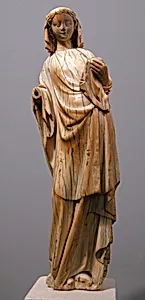
Standing Virgin and Child
Unknown Artist
ca. 1270–80
Medium
Ivory
Dimensions
Overall: 10 1/2 x 3 1/16 x 1 13/16 in. (26.7 x 7.8 x 4.6 cm)
Classification
Ivories
Culture
North French
Department
Medieval Art
Museum
Metropolitan Museum of Art, New York, NY
Credit
Gift of J. Pierpont Morgan, 1917
Accession Number
17.190.165
Rights
Public Domain
Art Historical Context
This exquisite *Standing Virgin and Child*, around 1270–80 by an unknown North French artist, captures the tender bond between Mary and the infant Jesus in compact ivory sculpture measuring just 10½ inches tall. Housed in the Metropolitan Museum of Art's Medieval Department—thanks to a generous 1917 gift from J Pierpont Morgan—this piece exemplifies the devotional art of 13th-century France during the High Gothic era, when such intimate figures were cherished for personal piety. Crafted from elephant ivory, a luxurious and symbolically pure material prized in medieval Europe, the sculpture showcases the virtuoso carving techniques of northern French workshops. Ivory's smooth, luminous surface allowed for delicate detailing—the Virgin's flowing drapery, serene expression, and the Child's gentle grasp—while its portability made it ideal for private prayer or altarpieces. The standing pose, with Mary slightly swaying in contrapposto, reflects evolving Gothic naturalism, blending spiritual grace with subtle human warmth. As a cultural artifact, this ivory embodies the era's intense Marian devotion, where the Virgin was revered as intercessor and queen of heaven. North French ivories like this one were exported across Europe, bridging religious fervor and artistic innovation, offering visitors a window into the heartfelt faith of the Middle Ages.