
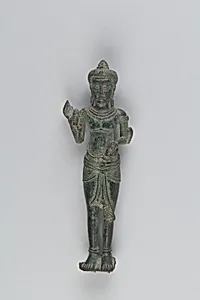
Standing Vishnu
Unknown Artist
12th century
Medium
Bronze
Dimensions
H. 5 1/4 in. (13.3 cm)
Classification
Sculpture
Culture
Thailand or Cambodia
Department
Asian Art
Museum
Metropolitan Museum of Art, New York, NY
Credit
Gift of Doris Wiener and Michele Caplan, in memory of Anthony Gardner, 1992
Accession Number
1992.188
Rights
Public Domain
Tags
Art Historical Context
Behold the exquisite *Standing Vishnu*, a 12th-century bronze sculpture Thailand or Cambodia, standing 5¼ inches tall. Crafted by an unknown artist during a golden age of Southeast Asian art, this diminutive yet majestic figure captures the Hindu god Vishnu in a poised, upright stance, embodying his role as the universe's divine preserver. Its compact size suggests it may have adorned a personal shrine or temple altar, making the sacred accessible in everyday devotion. Bronze was a prized medium in Khmer-influenced regions (encompassing much of modern Cambodia and Thailand), valued for its durability and the lost-wax casting technique that allowed for intricate details—like Vishnu's serene expression, ornate jewelry, and flowing garments. This period marked the height of Hindu-Buddhist syncretism under empires like Angkor, where sculptures like this bridged cosmology and craftsmanship, reflecting profound spiritual beliefs. Today, housed in the Metropolitan Museum of Art's Asian Art department (gift of Doris Wiener and Michele Caplan, 1992), *Standing Vishnu* invites us to marvel at ancient artistry's timeless grace, a testament to how metallurgy and mythology intertwined to inspire awe across centuries.