
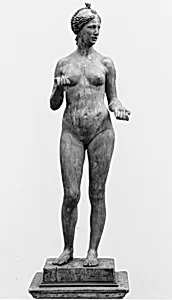
Standing woman (possibly Venus or Eve)
Unknown Artist
possibly 16th century
Medium
Fruitwood, with traces of paint
Dimensions
Height (figure): 65 in. (165.1 cm); Height (with plinth): 69 1/2 in. (176.5 cm); Base: 19 1/2 × 24 in. (49.5 × 61 cm)
Classification
Sculpture
Culture
possibly French
Department
European Sculpture and Decorative Arts
Museum
Metropolitan Museum of Art, New York, NY
Credit
The Jules Bache Collection, 1949
Accession Number
49.7.72
Rights
Public Domain
Tags
Art Historical Context
This graceful *Standing Woman (possibly Venus or Eve)* captivates with her poised, elongated form, carved from fruitwood—a durable hardwood favored for its fine grain and workability in Renaissance-era sculpture. Standing nearly 5.5 feet tall including its plinth, the figure's nude silhouette evokes classical ideals of beauty, with subtle traces of original paint hinting at once-vibrant polychromy that brought lifelike flesh tones and details to life. Likely from 16th-century France, it belongs to the European Sculpture and Decorative Arts tradition, where wood carvings served both devotional and decorative purposes in churches, homes, and courts. The ambiguity of her identity—mythological Venus, symbol of love and fertility, or biblical Eve, representing humanity's origins—mirrors the era's blend of pagan revival and Christian iconography during the Renaissance. French sculptors of this time drew from Italian models, emphasizing naturalistic anatomy and contrapposto stance to convey elegance and introspection. Part of The Jules Bache Collection at The Metropolitan Museum of Art since 1949, this piece offers a window into how everyday materials like fruitwood elevated intimate, human-scale nudes into profound artistic statements, bridging antiquity and the early modern world.