
Star-Shaped Tile
Unknown Artist
second half 13th–14th century
Medium
Stonepaste; molded, overglaze painted and leaf gilded (lajvardina)
Dimensions
D. 11/16 in. (1.7 cm) Diam. 7 7/8 in. (20 cm)
Classification
Ceramics-Tiles
Department
Islamic Art
Museum
Metropolitan Museum of Art, New York, NY
Credit
H.O. Havemeyer Collection, Gift of Horace Havemeyer, 1940
Accession Number
40.181.16
Rights
Public Domain
Art Historical Context
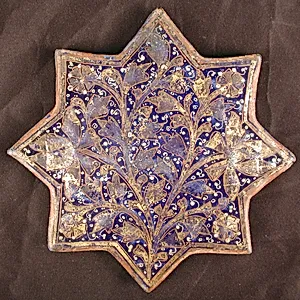
This exquisite star-shaped tile, crafted in the second half of the 13th–14th century,ails from the golden age of Islamic ceramics, likely produced in Iran. Measuring nearly 8 inches across, it exemplifies the architectural splendor of medieval mosques and palaces, where such tiles interlocked to form intricate star-and-polygon patterns adorning domes, mihrabs, and walls. Its deep cobalt-blue ground evokes the prized lapis lazuli (known as *lajvard* in Persian), symbolizing the heavens and divine beauty in Islamic art. The tile's medium—stonepaste (a fine fritware body)—was molded into its radiant star form, then masterfully finished with overglaze painting and leaf gilding in the rare *lajvardina* technique. This innovative process involved applying pigments and gold over a glazed surface, then firing at low temperatures to achieve luminous, iridescent effects. Such luxury finishes highlighted the technical prowess of potters in centers like Kashan, blending functionality with opulence. A gift to the Metropolitan Museum of Art from the H.O. Havemeyer Collection in 1940, this tile invites us to marvel at Islamic artisans' fusion of geometry, color, and light—enduring testaments to a vibrant cultural heritage.