
Star-Shaped Tile
Unknown Artist
13th–14th century
Medium
Stonepaste; inglaze painted in blue and turquoise and luster-painted on opaque white glaze
Dimensions
H. 8 in. (20.3 cm) W. 8 in. (20.3 cm) Wt. (the whole group): 51 lb. (23.1 kg)
Classification
Ceramics-Tiles
Department
Islamic Art
Museum
Metropolitan Museum of Art, New York, NY
Credit
H.O. Havemeyer Collection, Gift of Horace Havemeyer, 1941
Accession Number
41.165.18
Rights
Public Domain
Tags
Art Historical Context
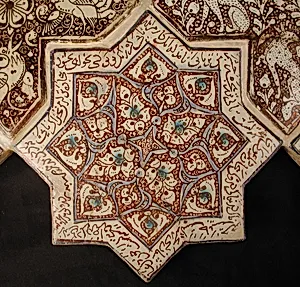
This exquisite star-shaped tile, crafted by an unknown artist in the13th–14th, hails from the Islamic world and exemplifies the architectural splendor of medieval mosques and palaces. Measuring 8 inches high and wide, it forms part of a larger ensemble weighing over 51 pounds, likely designed for intricate wall decorations known as muqarnas or star vaults. Its star form evokes celestial motifs, a recurring theme in Islamic art symbolizing the heavens and divine order. Made of stonepaste—a fine, vitreous ceramic body developed in the Middle East to mimic porcelain—the tile features sophisticated techniques: underglaze painting in vibrant blue and turquoise, topped with luster-painting on an opaque white glaze. This luster creates a shimmering, metallic iridescence that catches the light, a hallmark innovation from 13th-century Iran and Syria. Inscriptions of poetry, hinted at by its tags, would have adorned such tiles, blending artistic beauty with literary elegance. Housed in the Metropolitan Museum of Art's Islamic Art Department (gift of Horace Havemeyer, 1941), this tile invites visitors to marvel at the fusion of geometry, color, and verse that defined Islamic ceramic mastery, transforming buildings into poetic skies.