
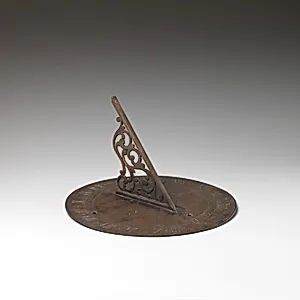
Stationary horizontal sundial
1793
Medium
Brass
Dimensions
Overall: 5 1/4 × 7 3/4 in. (13.3 × 19.7 cm)
Classification
Horology
Culture
British, London
Department
European Sculpture and Decorative Arts
Museum
Metropolitan Museum of Art, New York, NY
Credit
Gift of Mrs. Stephen D. Tucker, 1909
Accession Number
09.55.2
Rights
Public Domain
Tags
Art Historical Context
Step into the elegant world of18th-century British horology with Thomas Pipe's *Stationary Horizontal Sundial* (1793), a finely crafted brass instrument now housed in the Metropolitan Museum Art's Department of European Sculpture and Decorative Arts Measuring just 5¼ × 7¾ inches, this compact device exemplifies the precision engineering of London instrument makers during the Enlightenment. As a horizontal sundial, it relies on a fixed gnomon—a projecting style—to cast the sun's shadow onto a marked dial, revealing local time based on the observer's latitude. Pipe, a skilled London craftsman, produced this piece amid a surge in scientific curiosity, when sundials blended utility with decorative appeal. Brass was the ideal medium: durable, corrosion-resistant, and perfect for intricate engravings of hour lines, degree scales, and possibly seasonal adjustments. Such instruments were prized by scholars, navigators, and gentlemen collectors, reflecting Britain's leadership in astronomy and horology before widespread clock adoption. This rare survivor, gifted to the Met in 1909, highlights the cultural shift from solar to mechanical timekeeping. Visitors will appreciate its tactile beauty and the timeless ingenuity it represents—proof that even shadows can measure our days with artistry and accuracy.