
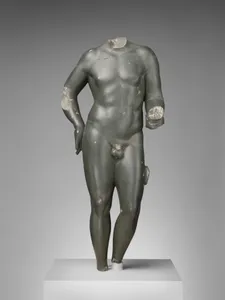
Statue of a boy
Unknown Artist
1st century CE
Medium
Bekhen stone
Dimensions
H. 21 3/4 in. (55.2 cm)
Classification
Stone Sculpture
Culture & Period
Roman · Early Imperial
Department
Greek and Roman Art
Museum
Metropolitan Museum of Art, New York, NY
Credit
Rogers Fund, 1920
Accession Number
20.201
Rights
Public Domain
Tags
Art Historical Context
This charming *Statue of a Boy* the Early Imperial Roman period (1st century CE) captures the youthful ideal classical sculpture. Carved Bekhen stone—a fine, greyish limestone quarried in ancient Egypt and favored for its smooth work—this 21¾-inch (55.2 cm) figure exemplifies Roman artistry's blend of Greek influences local innovation. Likely a portrait or votive offering, the nude male form reflects the Roman fascination with idealized youth, evoking themes of vitality and beauty seen in funerary or household shrines. Roman sculptors mastered Bekhen stone to achieve lifelike textures, from the boy's soft skin to subtle muscular definition, often polishing surfaces for a luminous effect. The contrapposto pose—weight shifted to one leg—borrows from Hellenistic traditions, showcasing anatomical precision and emotional expressiveness. Such statues adorned elite homes or tombs, symbolizing familial piety and the promise of eternal youth. Acquired through the Rogers Fund in 1920, this piece now graces the Metropolitan Museum of Art's Greek and Roman Art department, offering visitors a tangible link to imperial Rome's cultural splendor. Its modest scale invites close contemplation of antiquity's enduring grace.