
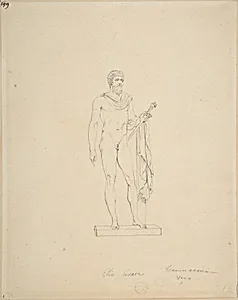
Statue of Caesar as a Divinity
Medium
Lead graphite
Dimensions
9 1/4 x 7 1/2in. (23.5 x 19.1cm)
Classification
Drawings
Department
Drawings and Prints
Museum
Metropolitan Museum of Art, New York, NY
Credit
Gift of Cephas G. Thompson, 1887
Accession Number
87.12.177
Rights
Public Domain
Tags
Art Historical Context
In the Metropolitan Museum of Art's Drawings and Prints department, Vincenzo Camuccini's *Statue of Caesar as Divinity* (ca. 1771–1844) captures the grandeur of ancient Rome through a precise graphite drawing on paper, measuring just 9¼ x 7½ inches. The Italian neoclassical artist, renowned for his meticulous studies of classical antiquity, renders a nude statue of Gaius Julius Caesar, the Roman dictator deified after his assassination in 44 BCE. This work exemplifies Camuccini's skill in evoking the idealized male form, blending historical reverence with the era's fascination for Greco-Roman sculpture. Camuccini's neoclassicism reflects the 19th-century revival of ancient ideals, where artists like him drew from Roman artifacts to celebrate imperial power and divine status. Caesar's portrayal as a god—complete with heroic nudity—echoes real ancient statues, symbolizing his transformation from conqueror to cult figure, complete with temples and priestly cults in his honor. The lead graphite medium allows for subtle shading and anatomical precision, highlighting muscular contours and poised divinity. Gifted to the Met in 1887 by Cephas G. Thompson, this intimate drawing invites visitors to ponder how Renaissance and neoclassical artists reinterpreted antiquity, bridging epochs in a single sheet. A testament to enduring fascination with Caesar's legacy.
About the Artist
Vincenzo Camuccini|Gaius Julius Caesar · 1771–1844
Comment on works: Portraits; History