
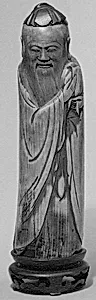
Statuette
Unknown Artist
15th century
Medium
Ivory
Dimensions
H. 11 11/16 in. (29.7 cm); W. 3 1/4 in. (8.3 cm)
Classification
Ivories
Culture & Period
China · early Ming dynasty (1368–1644)
Department
Asian Art
Museum
Metropolitan Museum of Art, New York, NY
Credit
Alfred W. Hoyt Collection, Bequest of Rosina H. Hoppin, 1965
Accession Number
65.86.121a, b
Rights
Public Domain
Tags
Art Historical Context
This exquisite ivory statuette crafted by an unknown artist 15th-century China the early Ming dynasty (8–1644), as a testament to the's masterful craftsmanship. Measuring11 11/16 (29.7 cm in height and 3 1/4 inches (8.3 cm) wide, it likely depicts a male figure— a scholar, official, or sage—captured in serene poise. Ivory, sourced from elephant tusks, was a luxurious medium prized for its smooth, luminous quality, allowing carvers to achieve intricate details and a lifelike translucency that mimicked jade, a material revered in Chinese culture. The early Ming period marked a cultural renaissance following the Mongol Yuan dynasty, with imperial patronage fostering refined arts that blended Song subtlety with bold innovation. Ivory carving flourished among court artisans, producing portable objects for the elite, from ritual items to desk ornaments. Techniques involved meticulous incising, polishing, and sometimes staining to enhance naturalistic folds in robes or expressive features, showcasing the sculptor's virtuosity in a compact form. Housed in the Metropolitan Museum of Art's Asian Art Department (Alfred W. Hoyt Collection, Bequest of Rosina H. Hoppin, 1965), this statuette invites visitors to appreciate Ming China's artistic elegance—where every curve reflects harmony between man and material, bridging the divine and the everyday.