
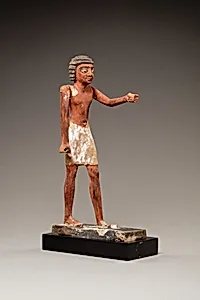
Statuette of a Striding Man in a Kilt
Unknown Artist
ca. 2030–1917 BC
Medium
Wood, paint, pinkish colored paste
Dimensions
H. 27.2 × W. 5.8 × D. 14.2 cm (10 11/16 × 2 5/16 × 5 9/16 in.)
Classification
Statuette of a Striding Man in a Kilt
Period
Early Middle Kingdom
Department
Egyptian Art
Museum
Metropolitan Museum of Art, New York, NY
Credit
Bequest of Nanette B. Kelekian, 2020
Accession Number
2021.41.170
Rights
Public Domain
Art Historical Context
This charming wooden statuette depicts a striding man dressed in a simple kilt, capturing the vitality of ancient Egyptian life during the Early Middle Kingdom (ca.2030–1917 BC). Standing about 27 cm tall, it hails from a time when Egypt was reunifying after the turmoil of the First Intermediate, with pharaohs like Mentuhotep II ushering in a renaissance of art and culture. Such figures were often placed in tombs to serve the deceased eternally, embodying the ka—the life force—in dynamic motion. Crafted from wood—a perishable medium that rarely survives—the statuette was vividly painted and enhanced with pinkish colored paste, likely to mimic the reddish-brown skin tones traditionally used for men in Egyptian art, symbolizing vitality and health. This technique highlights the Egyptians' mastery of polychromy, bringing sculptures to life with bold colors that have faded over millennia but still evoke their original vibrancy. Housed in the Metropolitan Museum of Art's Egyptian Art department through the generous bequest of Nanette B. Kelekian in 2020, this unknown artist's work offers a window into Middle Kingdom ideals of service, movement, and immortality. Imagine this striding figure forever offering sustenance in the afterlife— a testament to Egypt's enduring belief in eternity.