
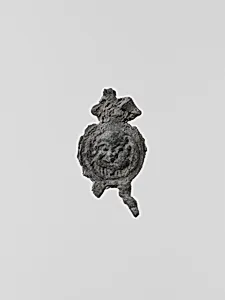
Statuette of a warrior-7
Unknown Artist
Medium
Lead
Dimensions
Height: 1 5/16 in. (3.3 cm)
Classification
Miscellaneous-Lead
Culture
Greek, Laconian
Department
Greek and Roman Art
Museum
Metropolitan Museum of Art, New York, NY
Credit
Gift of A. J. B. Wace, 1924
Accession Number
24.195.83
Rights
Public Domain
Tags
Art Historical Context
This diminutive lead statuette, standing just 1 5/16 inches (3.3 cm) tall, captures the essence of warrior from ancient Laconian Greece—the rugged heartland of Sparta. Crafted by an unknown artist, its small scale suggests it may have served as a vot offering, amulet, or even a toy, common uses for portable lead figures in the ancient world. Lead, a soft and malleable metal, was far less prestigious than bronze or marble but allowed for affordable production of such intimate human figures, making art accessible beyond elite temples. In Laconian culture, warriors embodied the Spartan ideal of discipline and martial prowess, where boys trained from childhood for battle. This statuette, housed in the Metropolitan Museum of Art's Greek and Roman Art Department, reflects that ethos through its human form tagged simply as a "warrior." Gifted in 1924 by archaeologist A.J.B. Wace, it offers a rare glimpse into everyday devotional or playful objects from a society famed for its austerity. Though its exact date remains unknown, the piece highlights lead's practical role in Greek craftsmanship, bridging the monumental with the miniature in a culture that revered both gods and soldiers.