
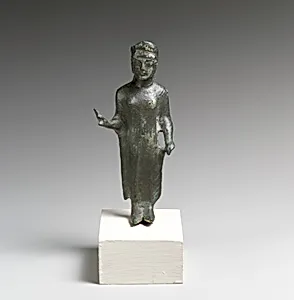
Statuette of a woman
Unknown Artist
4th century BCE
Medium
Bronze
Dimensions
H.: 6 3/8 x 2 1/4 x 1 1/16 in. (16.2 x 5.7 x 2.7 cm)
Classification
Bronzes
Culture
Etruscan
Department
Greek and Roman Art
Museum
Metropolitan Museum of Art, New York, NY
Credit
Fletcher Fund, 1925
Accession Number
25.78.36
Rights
Public Domain
Tags
Art Historical Context
This delicate bronze statuette of a woman, crafted in the 4th century BCE by an unknown Etruscan artist, stands just over 6 inches tall and captures the grace of ancient Italic artistry. Housed in the Metropolitan Museum of Art's Greek and Roman Art department (acquired through the Fletcher Fund in 1925), it exemplifies the Etruscans' mastery of bronze casting, a medium prized for its durability and ability to convey fine details like flowing drapery and poised gestures. Etruscan culture, flourishing in central Italy from around 900 to 100 BCE, bridged Greek influences and Roman traditions. Small-scale bronzes like this were often votive offerings at sanctuaries, grave accompaniments, or symbols of fertility and domestic life, reflecting women's vital roles in society—perhaps as priestesses, deities, or idealized figures. The Hellenistic-inspired realism in her form highlights evolving Etruscan styles, blending idealized beauty with subtle emotional depth. Though modest in size, this statuette offers a window into a vibrant, enigmatic civilization whose art influenced the emerging Roman world. Visitors can appreciate how such portable treasures brought the divine into everyday life, showcasing the Etruscans' technical prowess through likely lost-wax casting techniques that preserved intricate textures for millennia.