
Statuette of Aphrodite
late 6th century BC–early 4th century AD
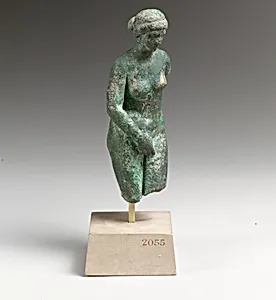
Medium
Bronze
Dimensions
H.: 4 7/8 x 2 in. (12.4 x 5.1 cm)
Classification
Bronzes
Culture
Roman
Department
Greek and Roman Art
Museum
Metropolitan Museum of Art, New York, NY
Credit
Rogers Fund, 1911
Accession Number
11.140.10
Rights
Public Domain
Tags
Art Historical Context
This exquisite bronze statuette of Aphrodite, attributed to the renowned Greek sculptor Praxiteles, captures goddess of love and beauty a graceful, intimate pose. Standing just under 5 inches tall, the work exemplifies the classical ideal of feminine form, with its smooth contours and subtle contrapposto evoking Praxiteles' signature Late Classical style from the 4th century. Acquired by the Metropolitan Museum of Art 1911 through the Rogers Fund, resides in the Greek and Roman department, highlighting the enduring influence of Greek artistry. Though classified as Roman in culture and dating broadly from the late 6th century BC to the early 4th century AD, this piece likely reflects Roman admiration for Hellenistic prototypes. Praxiteles revolutionized sculpture with his sensual, naturalistic figures, and small bronzes like this were prized in Roman households for private altars or as decorative treasures. Bronze, a durable yet malleable medium, allowed for intricate casting techniques, preserving fine details like the goddess's flowing drapery and poised elegance. Aphrodite's depiction underscores her central role in Greco-Roman mythology and worship, symbolizing desire, fertility, and divine allure. This statuette invites visitors to ponder how ancient devotees connected with the divine through such portable, personal art, bridging the worlds of gods and mortals across centuries.
About the Artist
Praxiteles
Praxiteles (flourished 370–330 BCE) stands as one of the most original and influential sculptors of ancient Greece, whose revolutionary approach to the human form profoundly altered the course of Western sculpture. Active during the fourth century BCE in Athens, Praxiteles transformed the detached, majestic style of earlier Greek sculpture into one of gentle grace and sensuous charm, introducing a...