
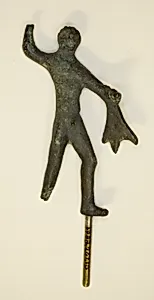
Statuette of Herakles
4th-3rd century BCE
Medium
Bronze
Dimensions
7.5 × 5 × 1.3 cm (2 7/8 × 2 × 1/2 in.)
Classification
statuette
Department
Arts of Greece, Rome, and Byzantium
Museum
Art Institute of Chicago
Accession Number
72219
Rights
Public Domain
Art Historical Context
This exquisite bronze statuette of Herakles, crafted by Ancient Etruscan artisans in the 4th-3rd century BCE, captures the mighty Greek hero—known to the Etruscans as Hercle—in compact form measuring just 7.5 × 5 × 1.3 cm. Likely produced using the sophisticated lost-wax casting technique common in the ancient Mediterranean, it exemplifies the Etruscans' mastery of bronze work, a medium prized for its durability and ability to convey muscular detail and dynamic poses. Herakles stands as a symbol of strength, often depicted in heroic feats, reflecting the Etruscans' admiration for Greek mythology. Dating to a period when Etruscan culture in central Italy was blending with Hellenistic influences, this piece highlights the civilization's role as a cultural bridge between Greece and Rome. The Etruscans, flourishing before Roman dominance, frequently adapted Greek gods and heroes into their own pantheon, using such statuettes for votive offerings in sanctuaries or as personal talismans. Its small scale suggests it was portable, perhaps carried by travelers or displayed in elite homes. Housed in the Art Institute of Chicago's Department of Arts of Greece, Rome, and Byzantium, this statuette offers a window into Etruscan artistry's vibrancy and innovation, reminding us how ancient myths transcended borders to inspire everyday devotion and awe.