
Stealing the Preserves
1815/20
Medium
Pen and red and black ink, with brush and watercolor, over traces of graphite, on ivory wove paper tipped onto cream wove paper
Dimensions
27.5 × 22 cm (10 7/8 × 8 11/16 in.)
Classification
watercolor
Department
Prints and Drawings
Museum
Art Institute of Chicago
Accession Number
114726
Rights
Public Domain
Art Historical Context
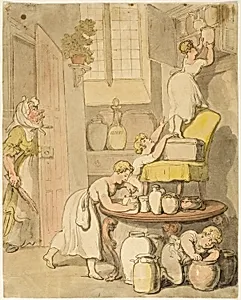
Thomas Rowlandson’s *Stealing the Preserves* (c. 1815–20) captures the cheeky humor of Regency-era Britain in a delightful watercolor. This British satirist, renowned for his caricatures poking fun at social follies, depicts a lighthearted scene of domestic mischief—likely a sneaky raid on the pantry—rendered with his signature exaggerated figures and witty details. Rowlandson, active during the late 18th and early 19th centuries, was master of the caricature tradition, blending sharp social commentary with playful exaggeration in works sold as affordable prints and drawings. Executed in pen and red and black ink with brush and watercolor over graphite traces on ivory wove paper (27.5 × 22 cm), the piece showcases Rowlandson’s fluid technique. The vibrant inks and washes bring vivacity to the composition, while the underdrawing reveals his spontaneous, improvisational style—hallmarks of his output from London’s bustling print shops. Tipped onto cream wove paper for preservation, it exemplifies the era’s innovative paper supports for portable art. Housed in the Art Institute of Chicago’s Prints and Drawings department, this gem highlights Rowlandson’s enduring appeal: his ability to lampoon everyday vices with infectious charm, offering visitors a window into the laughter and levity of Georgian life.
About the Artist
Thomas Rowlandson · 1756–1827
Thomas Rowlandson (1757–1827) was an English artist and caricaturist whose satirical watercolors and prints captured the social life of Georgian Britain with unparalleled wit and technical mastery. Alongside James Gillray, he is recognized as one of the greatest British graphic artists, and his distinctive flowing line and keen observations have made his work integral to understanding late 18th an...