
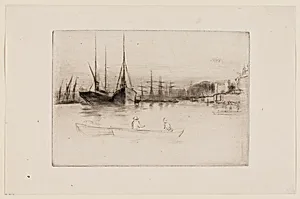
Steamboats off the Tower
Medium
Drypoint in black ink on off-white laid paper
Dimensions
Plate: 15.4 × 22.5 cm (6 1/8 × 8 7/8 in.); Sheet: 21.5 × 33.1 cm (8 1/2 × 13 1/16 in.)
Classification
drypoint
Department
Prints and Drawings
Museum
Art Institute of Chicago
Accession Number
29639
Rights
Public Domain
Art Historical Context
James McNeill Whistler’s *Steamboats off the Tower* (1875) captures the bustling energy of Victorian London’s Thames River, with steamboats gliding past the iconic Tower of London This intimate drypoint print, executed in black ink on off-white laid paper exemplifies Whistler’s shift toward subtle atmospheric effects during his mature career. A pioneer of Aestheticism, Whistler prioritized “art for art’s sake,” emphasizing tone, harmony, and suggestion over narrative detail—principles vividly evident here in the hazy interplay of light and shadow on water and vessels. Drypoint, Whistler’s favored technique for its directness, involves scratching lines into a metal plate with a sharp tool, raising a soft burr that yields rich, velvety blacks upon printing. Unlike etching’s precise lines, drypoint’s texture creates a painterly quality, and Whistler’s few impressions from the plate preserve the burr’s delicate richness. Measuring just 15.4 × 22.5 cm, this work from the Art Institute of Chicago’s Prints and Drawings collection highlights his experimental printmaking, bridging painting and graphics. Produced amid London’s industrial boom, the print reflects the era’s fascination with modernity while evoking a poetic transience. Whistler’s Thames series, including this gem, influenced later impressionists and established him as a virtuoso of subtle mood, inviting viewers to savor the fleeting beauty of an urban waterway.
About the Artist
James McNeill Whistler · 1834–1903
James Abbott McNeill Whistler (1834-1903) was an American-born painter and printmaker who became a leading figure in the Aesthetic Movement and pioneer of Tonalism and Japonisme. He revolutionized art by championing "art for art's sake" and treating paintings as visual equivalents of musical compositions, titling works as "arrangements," "harmonies," and "nocturnes" to emphasize formal qualities o...