
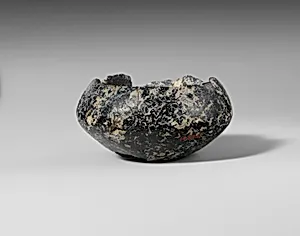
Steatite bowl
Unknown Artist
ca. 2200–1900 BCE
Medium
Steatite
Dimensions
H. 1 7/8 in. (4.8 cm); Diameter 3 5/8 in. (9.2 cm)
Classification
Miscellaneous-Stone Vases
Culture & Period
Minoan · Middle Minoan I
Department
Greek and Roman Art
Museum
Metropolitan Museum of Art, New York, NY
Credit
The Cesnola Collection, by exchange, 1914
Accession Number
14.89.15
Rights
Public Domain
Art Historical Context
This delicate steatite bowl, crafted 2200–1900 BCE during the Middle Minoan I period, offers a glimpse into the early sophistication of Minoan culture on the island of Crete. Standing just 1 7/8 inches tall with a 3 5/8-inch diameter, its petite form suggests it was likely used for, perfumes, or ritual offerings by Crete's emerging elite. Steatite, or soapstone, was prized for its softness, allowing artisans to carve smooth, lustrous surfaces with precision using simple tools like obsidian blades—a testament to the Minoans' advanced craftsmanship in the Bronze Age Aegean. As one of the earliest phases of Minoan civilization, Middle Minoan I marks the transition toward complex palace societies like Knossos, where stone vessels like this symbolized status and technological prowess. Unlike coarser pottery, steatite bowls endured daily use while evoking luxury, often polished to a soft sheen that mimicked more precious materials. Though undecorated, its simple elegance reflects the period's focus on form and function. Housed in the Metropolitan Museum of Art's Greek and Roman Art department from The Cesnola Collection (acquired by exchange in 1914), this unassuming artifact bridges us to a vibrant seafaring world, hinting at trade networks that connected Crete to the wider Mediterranean.