
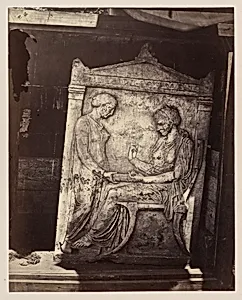
Stele from the Kerameikos Cemetery, Athens
early 1880s
Medium
Albumen silver print from glass negative
Dimensions
10 5/16 x 8 3/16
Classification
Photographs
Department
Photographs
Museum
Metropolitan Museum of Art, New York, NY
Credit
Gilman Collection, Museum Purchase, 2005
Accession Number
2005.100.1313
Rights
Public Domain
Art Historical Context
Step into the ancient world through William James Stillman's captivating *Stele from the Kerame Cemetery, Athens*, an albumen silver print from the 1880s. Stillman, an American photographer archaeophile, documented Greece's classical treasures during his time in Athens, capturing this funerary stele—a carved stone monument from the Kerameikos, ancient Athens' principal cemetery. Dating back to the Classical Greek period (5th–4th century BCE), such stelai often featured reliefs honoring the deceased, blending personal portraiture with symbolic motifs of farewell. Crafted as a precise 10 5/16 x 8 3/16-inch print from a glass negative, this photograph exemplifies 19th-century albumen technology. The albumen process, using egg whites to bind light-sensitive silver salts, produced richly toned images with exceptional clarity, ideal for preserving archaeological details that might otherwise fade from view. Stillman's steady hand and archaeological eye transformed the stele into a bridge between eras, allowing modern viewers to study its inscriptions and sculptural finesse. Housed in The Metropolitan Museum of Art's Gilman Collection, this work underscores photography's role in 19th-century scholarship. It not only safeguards a piece of Athenian mourning culture—reflecting societal values around death and memory—but also highlights Stillman's contribution to early art documentation, making antiquity accessible to all.
About the Artist
William James Stillman · 1828–1901
Stillman worked as a landscape painter in New York City from 1848 to 1858. In 1859, he produced a series of photographs on the Adirondack region. That same year, moved to Europe and from 1861 to 1865, he served as the American consul in Rome. During this period he produced a series of topographical and architectural photographs of Rome and Florence. From 1865 to 1868, Stillman served as the consul...