
Stencil
Unknown Artist
19th century
Medium
Paper, silk
Dimensions
22 1/2 x 17 1/8 in. (57.2 x 43.5 cm)
Classification
Stencils
Culture
Japan
Department
Asian Art
Museum
Metropolitan Museum of Art, New York, NY
Credit
Gift of Mrs. Horace Havemeyer, 1942
Accession Number
42.91.44
Rights
Public Domain
Art Historical Context
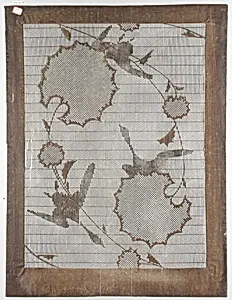
This exquisite 19th Japanese stencil, crafted from delicate paper reinforced with silk threads exemplifies the artistry of *katami*—intricately cut templates used for dyeing textiles. Measuring 22½ x 17⅛ inches, it was a tool of precision, allowing artisans to transfer elaborate patterns onto fabrics for kimonos,i sashes, and other garments The silk reinforcement prevented tearing during repeated use, showcasing meticulous craftsmanship of specialist stencil-makers often from regions like Hinohe or Kyoto. In Japan's Edo and Meiji periods, st revolutionized textile production, bridging traditional handcraft with emerging mass manufacturing. They enabled vibrant, repeating motifs inspired by nature, theater, daily life—echoing uyo-e aesthetics—while the beauty of hand-dyedūzen fabrics. These tools democratized luxury, making patterned silks accessible beyond the elite. Today, housed in the Metropolitan Museum of Art's Asian Art Department as a gift from Mrs. Horace Havemeyer in 1942, this masterpiece highlights Japan's enduring legacy of innovation in decorative arts. Visitors can appreciate how such humble objects fueled a golden age of fashion and design.