
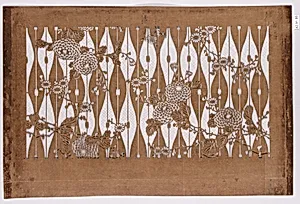
Stencil
Unknown Artist
19th century
Medium
Paper, silk
Dimensions
11 x 16 3/4 in. (27.9 x 42.5 cm)
Classification
Stencils
Culture
Japan
Department
Asian Art
Museum
Metropolitan Museum of Art, New York, NY
Credit
Gift of Mrs. Horace Havemeyer, 1942
Accession Number
42.91.85
Rights
Public Domain
Tags
Art Historical Context
This exquisite 19th-century Japanese stencil, housed in the Metropolitan Museum of's Asian Art department, a modest 11 x 16 3/4 inches (27.9 x 42.5 cm) and is crafted from delicate paper and silk. Donated in 1942 by Mrs. Horace Havemeyer, exemplifies the precision of anonymous artisans who produced these tools for textile decoration. The floral motifs, hinted at in its design, reflect Japan's enduring fascination with nature's beauty, where flowers often symbolized seasons, renewal, and harmony. In Edo-period Japan (extending into the 19th century), stencils like this were vital for katazome, a resist-dyeing technique used to create intricate patterns on kimonos and fabrics. Thin silk threads, integrated into the paper, reinforced the fine cuts, preventing tears during repeated applications of rice-paste resist and dye. This innovative medium allowed for complex, repeatable designs that blended artistry with functionality. As a window into everyday craftsmanship, this stencil highlights Japan's mastery of utilitarian beauty, bridging art and daily life. Visitors can appreciate how such humble objects elevated textiles into wearable poetry.