
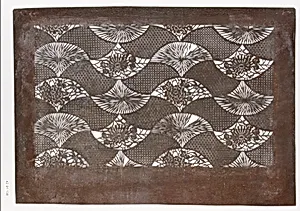
Stencil
Unknown Artist
19th century
Medium
Paper
Dimensions
11 1/4 x 16 in. (28.6 x 40.6 cm)
Classification
Stencils
Culture
Japan
Department
Asian Art
Museum
Metropolitan Museum of Art, New York, NY
Credit
Gift of Mrs. Horace Havemeyer, 1942
Accession Number
42.91.138
Rights
Public Domain
Tags
Art Historical Context
This delicate 19th-century Japanese, crafted on paper and measuring 11¼ x 16 inches, the intricate artistry of katagami—hand-cut templates used in katazome, a resist-dyeing technique for textiles kimonos. Produced during Japan's Edo or early Meiji period, when floral motifs flourished in decorative arts, this piece likely features blooming flowers, symbols of seasonal beauty and transience in Japanese aesthetics. precise cuts, often reinforced with silk threads to prevent tearing, allowed artisans to transfer vibrant patterns onto fabric with remarkable fidelity. As a tool of everyday craft elevated to fine art, the stencil highlights the fusion of utility and mastery in Japanese culture. These objects were essential in workshops producing luxurious garments for festivals and nobility, preserving motifs from nature that echoed ukiyo-e prints and ceramics. Donated to the Metropolitan Museum of Art in 1942 by Mrs. Horace Havemeyer, a renowned collector of Asian treasures, it invites us to appreciate the unseen labor behind Japan's textile heritage. Today, in the Met's Asian Art Department, this anonymous creation reminds visitors of how everyday tools can embody profound cultural elegance and technical innovation.