
Stencil
Unknown Artist
Medium
Paper
Dimensions
19 3/4 x 15 1/4 in. (50.16 x 38.73 cm)
Classification
Stencils
Culture & Period
Japan · Edo period (1615–1868)
Department
Asian Art
Museum
Metropolitan Museum of Art, New York, NY
Credit
Gift of Clarence McKenzie Lewis, 1953
Accession Number
53.101.24
Rights
Public Domain
Tags
Art Historical Context
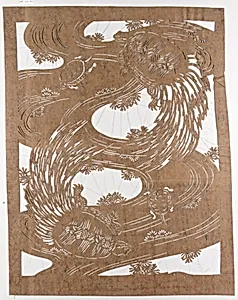
This delicate stencil, crafted from paper during Japan's Edo period (16151868), exemplifies the ingenuity of traditional Japanese artisans. Measuring 19 3/4 x 15 1/4 inches, it features motifs of turtles—symbols of longevity, wisdom, and good fortune in Japanese culture.urtles often appear in art evoking stability and endurance, reflecting the era's fascination with nature's enduring cycles. Edo stencils, known as *katagami*, were essential tools for *katazome* (stencil dyeing), a resist-dyeing technique used to create intricate patterns on kimonos, noren curtains, and other textiles. Artisans meticulously cut these thin mulberry paper stencils by hand using specialized knives, layering silk threads for reinforcement to prevent tearing during repeated use. This labor-intensive process allowed for precise, vibrant designs that democratized beauty in everyday garments during a time of urban prosperity and flourishing crafts. Housed in the Metropolitan Museum of Art's Asian Art department as a gift from Clarence McKenzie Lewis in 1953, this anonymous work highlights the unsung mastery of Edo craftspeople. It invites us to appreciate how functional tools doubled as miniature artworks, bridging utility and aesthetics in Japanese design.