
Stencil
Unknown Artist
19th century
Medium
Paper
Dimensions
16 1/4 x 10 1/2 in. (41.3 x 26.7 cm)
Classification
Stencils
Culture & Period
Japan · Edo period (1615–1868)
Department
Asian Art
Museum
Metropolitan Museum of Art, New York, NY
Credit
Purchase, Mrs. Helen M. Meserve Gift, 1981
Accession Number
1981.10.8
Rights
Public Domain
Art Historical Context
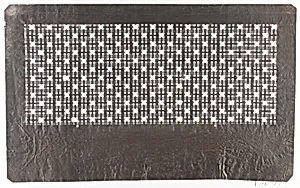
This delicate paper stencil from 19th-century Japan, created during the Edo period (1615–1868), exemplifies the exquisite craftsmanship of katagami, traditional stencils used in textile dyeing. Measuring 16¼ × 10½ inches (41.3 × 26.7 cm), it was meticulously cut from thin mulberry paper, often reinforced with fine silk threads to preserve intricate motifs amid the resist-dyeing process known as katazome. Artisans would apply rice paste through the stencil onto fabric, then dye it, creating vibrant, repeating patterns for kimonos and other garments favored by the era's thriving merchant class. The Edo period marked a golden age of Japanese urban culture, where peace and prosperity fueled innovations in printmaking and decorative arts. Stencils like this one were essential tools for mass-producing luxurious textiles, blending functionality with artistic precision. Their designs—typically floral, geometric, or theatrical—influenced ukiyo-e woodblock prints and everyday fashion, reflecting Japan's sophisticated blend of utility and beauty. Today, housed in the Metropolitan Museum of Art's Asian Art Department (Purchase, Mrs. Helen M. Meserve Gift, 1981), this anonymous masterpiece invites us to appreciate the unsung skill of Edo craftspeople, whose ephemeral tools produced enduring cultural icons.