
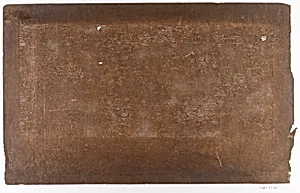
Stencil
Unknown Artist
19th century
Medium
Paper
Dimensions
16 1/4 x 10 1/2 in. (41.3 x 26.7 cm)
Classification
Stencils
Culture & Period
Japan · Edo period (1615–1868)
Department
Asian Art
Museum
Metropolitan Museum of Art, New York, NY
Credit
Purchase, Mrs. Helen M. Meserve Gift, 1981
Accession Number
1981.10.60
Rights
Public Domain
Art Historical Context
This delicate stencil, crafted in 19-century Japan during the Edo period (16151868), exemplifies the ingenuity of Japanese artisans in textile production. Made from paper and measuring 16¼ × 10½ inches (41.3 × 26.7 cm), it belongs to a tradition of *kata*—intricately cut stencils used for *katazome*, a-dyeing technique that allowed for vibrant, repeatable patterns on kimonos and other fabrics. The Edo era's urban prosperity fueled a booming fashion culture in cities like Edo (modern Tokyo), where such tools democratized elaborate designs for everyday wear. What makes this stencil remarkable is its precision: layers of mulberry paper were skillfully incised with knives to create fine motifs, often floral or geometric, that resisted dye while allowing color to permeate open areas. This labor-intensive method highlighted Japan's mastery of craftsmanship, blending utility with artistry. Though the artist remains unknown, the object's survival speaks to the enduring value placed on these tools in preserving cultural aesthetics. Acquired by The Metropolitan Museum of Art through the Mrs. Helen M. Meserve Gift in 1981, this piece invites visitors to appreciate the hidden artistry behind Japan's iconic textiles, bridging craft and commerce in a transformative era.