
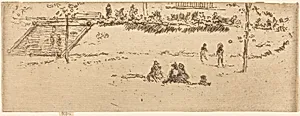
Steps, Gray's Inn
c. 1886/1888
Medium
etching on laid paper
Dimensions
overall (trimmed to plate): 6.5 × 17.8 cm (2 9/16 × 7 in.)
Classification
Department
CG-W
Museum
National Gallery of Art, Washington, D.C.
Credit
Rosenwald Collection
Accession Number
1943.3.8598
Rights
Public Domain
Art Historical Context
In the late 1880s, James McNeill Whistler, American-born artist renowned for his Aesthetic movement ideals of "art for art's sake," the quiet elegance of London's Gray's Inn in this intimate etching. *Steps, Gray's Inn* (c. 188/1888) depicts the historic stone steps of this venerable legal precinct within the Inns of Court, hub of British jurisprudence since the 14th century. Whistler's precise lines evoke a sense of timeless urban poetry, transforming an everyday architectural feature into a harmonious composition of light, shadow, and texture. Printed on laid paper—a traditional support with visible chain lines that adds to its tactile authenticity—this etching measures a modest 6.5 × 17.8 cm, trimmed to the plate for a focused intimacy. Whistler's etching technique, honed through series like his Venetian views, masterfully balances intricate drypoint burrs and aquatint tones to suggest atmospheric depth without overt detail. This work exemplifies his printmaking genius, where subtlety reigns over narrative. Housed in the National Gallery of Art's Rosenwald Collection, *Steps, Gray's Inn* invites visitors to appreciate Whistler's influence on modern printmaking, bridging 19th-century realism with abstract beauty. A gem for those exploring London's layered history through an artist's discerning eye.
About the Artist
James McNeill Whistler · 1834–1903
James Abbott McNeill Whistler (1834-1903) was an American-born painter and printmaker who became a leading figure in the Aesthetic Movement and pioneer of Tonalism and Japonisme. He revolutionized art by championing "art for art's sake" and treating paintings as visual equivalents of musical compositions, titling works as "arrangements," "harmonies," and "nocturnes" to emphasize formal qualities o...