
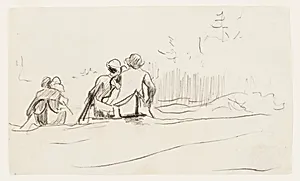
Stern View of Two Canoes
Medium
landscapes
Classification
landscapes
Department
Smithsonian Collection
Museum
Smithsonian American Art Museum
Credit
Gift of Charles Savage Homer, Jr.
Accession Number
1912-12-228
Rights
Public Domain
About this artwork
Research in Progress
Art Historical Context
Winslow Homer (18361910), a leading figure in American Realism, crafted *Stern View of Twoes* in 1897, a captivating landscape now housed in the Smithsonian American Art Museum.ed by Charles Savage Homer, Jr., work showcases Homer's masterful eye for the American wilderness, focusing on two canoes seen from behind as they glide through tranquil waters. His realistic style emphasizes the interplay of light, reflection, and natural forms, inviting viewers to feel the quiet rhythm of outdoor life. By the late 1890s, Homer had largely withdrawn to his Prouts Neck, Maine studio, immersing himself in depictions of nature's drama—from stormy seas to serene inland scenes. This piece reflects that period's shift toward intimate, observational landscapes, capturing the era's growing fascination with leisure pursuits like canoeing in remote areas such as the Adirondacks. Homer's technique, with its bold brushwork and luminous effects, underscores his transition from Civil War illustrations to profound meditations on humanity's place in the wild. Though research on this specific canvas continues, *Stern View of Two Canoes* exemplifies Homer's enduring legacy: celebrating America's rugged beauty and the solitude it offers. Pause to notice the subtle ripples and horizon—details that reveal his genius for evoking peace amid vastness.