
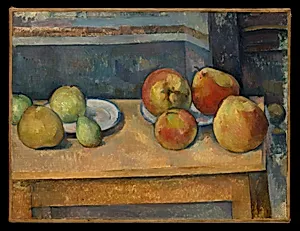
Still Life with Apples and Pears
ca. 1891–92
Medium
Oil on canvas
Dimensions
17 5/8 x 23 1/8 in. (44.8 x 58.7 cm)
Classification
Paintings
Department
European Paintings
Museum
Metropolitan Museum of Art, New York, NY
Credit
Bequest of Stephen C. Clark, 1960
Accession Number
61.101.3
Rights
Public Domain
Tags
Art Historical Context
Paul Cézanne's *Still Life with Apples andears* (ca. 1891–92) is a quintessential example of the artist's groundbreaking approach to everyday subjects. Painted in oil on canvas, this modest 17⅝ × 23⅛-inch work captures a simple arrangement of apples and pears, rendered with Cézanne's signature Post-Impressionist style. During the late 19th century, as Impressionism waned, Cézanne focus from fleeting light effects to the underlying structure of forms, treating fruits not as mere objects but as building blocks of space and volume. What makes this painting historically significant is Cézanne's innovative technique: he built compositions through deliberate brushstrokes that suggest multiple viewpoints, creating a sense of solidity and depth. His still lifes, like this one, influenced generations of artists, paving the way for Cubism and modern abstraction. Housed in the Metropolitan Museum of Art's European Paintings department through the 1960 bequest of Stephen C. Clark, it exemplifies how ordinary table fruits could embody profound artistic exploration. Visitors will appreciate the tactile quality of the canvas—its subtle color modulations invite close inspection, revealing Cézanne's quest to "treat nature by means of the cylinder, the sphere, the cone." A timeless gem for fruit lovers and art enthusiasts alike!
About the Artist
Paul Cézanne · 1839–1906
Paul Cézanne (1839-1906) stands as one of the most influential figures in the history of modern art, often called the "Father of Modern Art" for his revolutionary approach to form, color, and pictorial space. Born in Aix-en-Provence to a wealthy banker who discouraged artistic pursuits, Cézanne rejected a legal career to pursue painting, though he remained financially dependent on his family until...