
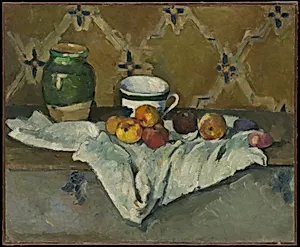
Still Life with Jar, Cup, and Apples
ca. 1877
Medium
Oil on canvas
Dimensions
23 7/8 x 29 in. (60.6 x 73.7 cm)
Classification
Paintings
Department
European Paintings
Museum
Metropolitan Museum of Art, New York, NY
Credit
H. O. Havemeyer Collection, Bequest of Mrs. H. O. Havemeyer, 1929
Accession Number
29.100.66
Rights
Public Domain
Tags
Art Historical Context
Step into the quiet elegance of Paul Cézanne's *Still Life with Jar,, and Apples* (ca. 1877), a masterful oil on canvas now housed in the Metropolitan Museum Art's European Paintings department. Measuring nearly 24 by 29 inches, this work captures everyday objects—a jar, a cup, and a cluster of apples—arranged on a table, bathed in soft, diffused light. Canne, a French Post-Impressionist, elevates the humble still life genre, transforming ordinary items into profound studies of form and space. Created during a pivotal phase in Cézanne's career, around the time he was distancing himself from pure Impressionism, the painting showcases his revolutionary technique: building volume and depth through deliberate brushstrokes and modulated color patches rather than precise outlines. His apples, a recurring motif in over 200 still lifes, symbolize solidity and permanence, challenging the fleeting effects of light prized by his contemporaries like Monet. Part of the esteemed H. O. Havemeyer Collection bequeathed in 1929, this piece highlights Cézanne's enduring influence as the "father of modern art." Pioneering a structured approach that paved the way for Cubism, it invites viewers to ponder how simple objects can reveal the geometry of the world. A timeless gem for any museum stroll!
About the Artist
Paul Cézanne · 1839–1906
Paul Cézanne (1839-1906) stands as one of the most influential figures in the history of modern art, often called the "Father of Modern Art" for his revolutionary approach to form, color, and pictorial space. Born in Aix-en-Provence to a wealthy banker who discouraged artistic pursuits, Cézanne rejected a legal career to pursue painting, though he remained financially dependent on his family until...