
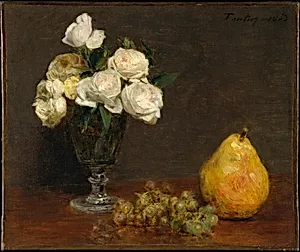
Still Life with Roses and Fruit
Medium
Oil on canvas
Dimensions
13 5/8 x 16 3/8 in. (34.6 x 41.6 cm)
Classification
Paintings
Department
European Paintings
Museum
Metropolitan Museum of Art, New York, NY
Credit
Bequest of Alice A. Hay, 1987
Accession Number
1987.119
Rights
Public Domain
Tags
Art Historical Context
Henri Fantin-Latour's *Still Life with Roses and Fruit* (1863) is a exquisite example of 19th-century French still life painting, capturing the delicate beauty of roses and ripe pears in oil on canvas. Measuring just 13⅝ × 16⅜ inches, this intimate work invites viewers to linger over its luminous blooms and textured fruits, arranged with quiet elegance against a dark background. Painted during Fantin-Latour's early maturity, it showcases his mastery of Realism, influenced by 17th-century Dutch masters like Willem Kalf, yet distinctly modern in its subtle play of light and shadow. Fantin-Latour, a Paris-based artist and friend to figures like Édouard Manet and James McNeill Whistler, elevated still life to a celebration of sensory detail. His technique—meticulous brushwork rendering the velvety petals of roses and the glossy skins of pears—demonstrates extraordinary trompe-l'œil effects, making the objects seem tangible. Oil on canvas allowed for these rich, jewel-like colors and depths, a medium that highlighted his precision and patience. Housed in the Metropolitan Museum of Art's European Paintings department through the bequest of Alice A. Hay in 1987, this piece reflects the era's fascination with nature's ephemerality amid France's Second Empire prosperity. It reminds us how everyday abundance could symbolize deeper vanities of life, offering timeless delight to museum visitors.
About the Artist
Henri Fantin-Latour · 1836–1904
Ignace Henri Jean Théodore Fantin-Latour was born on January 14, 1836, in Grenoble, France, to portrait painter Théodore Fantin-Latour, who gave him his earliest drawing lessons. The family relocated to Paris in 1841, where in 1850, at age 14, he enrolled in the École de Dessin, studying under Horace Lecoq de Boisbaudran, whose innovative memory-based method of drawing from observation profoundly ...