
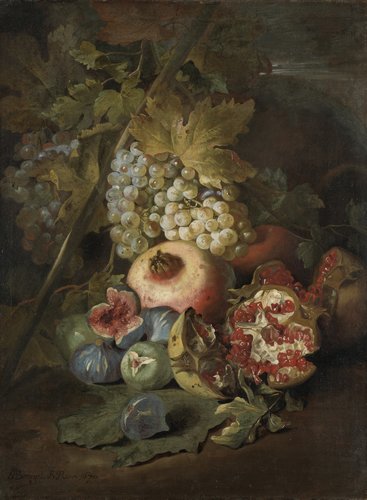
Stilleven met druiven, granaatappels en vijgen
1670
Medium
oil on canvas
Dimensions
66; 8; 49.5
Rights
Public Domain
About this artwork
…; anonymous sale, [Ledeboer and Roest van Limburg], Amsterdam (Van Pappelendam & Schouten), 13 December 1887, no. 11, fl. 121, to C.F. Roos, for the museum;{Copy RKD. NHA, ARS, IS, inv. 168, no. 264 (2 January 1888); NHA, ARS, Kop, inv. 289, p. 165, no. 370 (10 January 1888).} on loan to the Dutch embassy, Moscow, 1947; on loan through the DRVK, 1953-61; on loan to the Kantongerecht, Haarlem, 1961-85; transferred to the RBK, The Hague, 1985-92; on loan to the Dutch ambassador’s residence, Bonn,...
Art Historical Context
In this oil on canvas, Abraham Brueghel arranges a lush still life of ripe fruits against a dark, earthy background. Clusters of pale grapes hang from a vine at the upper left, while a whole pomegranate sits beside split ones that reveal glistening red seeds. Blue and green figs, some halved to show their pink interiors, rest among broad leaves at the base, their textures rendered with careful attention to light and surface. Brueghel, working in Rome in 1670, brings the Flemish tradition of detailed naturalism to Italian settings. The painting captures the abundance of the harvest through rich colors and precise brushwork, inviting close looking at the contrast between smooth grape skins, velvety fig flesh, and jewel-like pomegranate arils. Titled *Stilleven met druiven, granaatappels en vijgen*, the work exemplifies seventeenth-century still-life painting’s celebration of nature’s variety and beauty. Its modest scale encourages visitors to appreciate the artist’s skill in transforming everyday produce into a quietly opulent composition.