
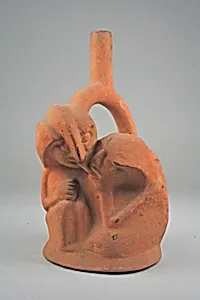
Stirrup Spout Bottle with Couple
Unknown Artist
3rd–7th century
Medium
Ceramic, slip
Dimensions
H. 8 3/4 x W. 5 in. (22.2 x 12.7 cm)
Classification
Ceramics-Containers
Culture
Moche
Department
Arts of Africa, Oceania, and the Americas
Museum
Metropolitan Museum of Art, New York, NY
Credit
Gift of Nathan Cummings, 1965
Accession Number
65.266.69
Rights
Public Domain
Tags
Art Historical Context
This ceramic stirrup-spout bottle, created by an unknown Moche artist between the 3rd and 7th centuries, offers a window into the vibrant artistic world of ancient Peru. The Moche people, who thrived along the northern coast, are celebrated for their highly realistic ceramics that captured scenes from daily life, rituals, and human relationships. Standing just over 8 inches tall, this vessel features a couple, a motif that reflects the culture’s interest in social and intimate themes. Moche potters were masters of their craft, using molds to shape forms and applying colored slips—liquid clay mixtures—for smooth surfaces and painted details. The distinctive stirrup spout, resembling a riding stirrup, was both practical for pouring liquids with minimal evaporation and a hallmark of Andean ceramics, often reserved for ceremonial or elite use. Such bottles were commonly placed in tombs, suggesting they played a role in funerary beliefs and the afterlife. This piece, now in the Metropolitan Museum of Art thanks to a 1965 gift from Nathan Cummings, highlights the Moche’s ability to blend functionality with narrative artistry. It invites viewers to consider how these ancient creators documented their society through enduring clay forms.