
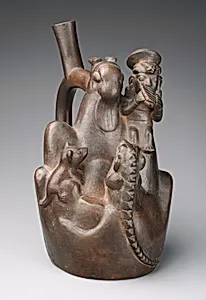
Stirrup-spout bottle with mountain sacrifice scene
500–800 CE
Medium
Ceramic, slip
Dimensions
H. 8 1/4 × W. 5 × D. 7 1/2 in. (21 × 12.7 × 19.1 cm)
Classification
Ceramics-Containers
Culture
Moche
Department
Arts of Africa, Oceania, and the Americas
Museum
Metropolitan Museum of Art, New York, NY
Credit
Gift of Mr. and Mrs. Nathan Cummings, 1964
Accession Number
64.228.64
Rights
Public Domain
Tags
Art Historical Context
This exquisite stirrup-spout bottle, crafted by a Moche artist between and 800 CE, exemplifies masterful ceramics of the Moche culture from ancient Peru's northern coast. The vessel's distinctive form—a double-chambered body connected by looped "stirrup" handle leading to a spout—was designed for pouring liquids like chicha (corn beer) in rituals. Made from ceramic with colorful slip paints, it stands about 8 inches tall, its surface vividly depicting a dramatic mountain sacrifice scene featuring men and animals, a common motif in Moche art that likely references real or mythic ceremonies. The Moche, who thrived from around 100 to 800 CE before the rise of the Inca, were renowned for their narrative pottery, which served as both functional containers and storytelling devices. These bottles often illustrated elite rituals, warfare, and human-animal interactions, offering rare glimpses into their worldview. The slip technique—applying liquid clay pigmented with minerals before firing—allowed for intricate details and bold colors, showcasing the potter's skill in modeling, painting, and firing without a wheel. Today, this bottle graces the Metropolitan Museum of Art's collection, gifted in 1964. It highlights the Moche's artistic innovation and cultural emphasis on sacrifice as a means of cosmic renewal, inviting us to ponder the spiritual lives of a vanished civilization.