
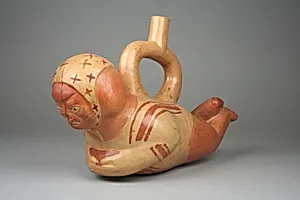
Stirrup Spout Bottle with Reclining Figure
Unknown Artist
1st–6th century
Medium
Ceramic, slip, pigment
Dimensions
H. 7 1/4 x W. 10 3/4 in. (18.4 x 27.3 cm)
Classification
Ceramics-Containers
Culture
Moche
Department
Arts of Africa, Oceania, and the Americas
Museum
Metropolitan Museum of Art, New York, NY
Credit
Gift of Judith Riklis, 1983
Accession Number
1983.546.21
Rights
Public Domain
Tags
Art Historical Context
This exquisite Stirrup Spout Bottle Reclining Figure, by an unknown Moche artist between the 1st and 6th centuries, hails from the ancient Moche culture of Peru's northern coast. The Moche, flourishing from around 100–700 CE, were renowned for their masterful ceramics that blended functionality with vivid storytelling. These vessels were not mere containers but cultural treasures, often used in rituals, burials, or daily life, reflecting the society's deep interest in human forms, myths, and social hierarchies. The bottle's distinctive stirrup spout—a looped handle joining twin spouts—allowed secure pouring of liquids like chicha (corn beer) while minimizing spills, a practical innovation in Moche pottery. Fashioned from ceramic with colorful slip (liquid clay) and pigments, its surface captures a reclining human figure in dynamic repose, likely evoking themes of rest, fertility, or elite leisure. Measuring just 7¼ x 10¾ inches, its compact scale belies the precision of Moche techniques, including mold-making, coiling, and post-fire painting for striking realism. Housed in the Metropolitan Museum of Art's Arts of Africa, Oceania, and the Americas department (gift of Judith Riklis, 1983), this piece exemplifies Moche artistry's narrative power, offering a window into a civilization that valued portraiture centuries before the Renaissance. Visitors, imagine sipping from such a vessel in an ancient Andean ritual!