
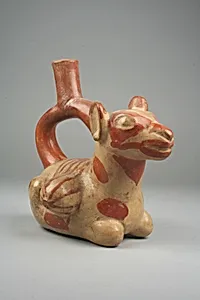
Stirrup Spout Bottle with Reclining Llama
Unknown Artist
1st–6th century
Medium
Ceramic, slip, pigment
Dimensions
H. 6 1/8 x W. 4 5/16 in. (15.6 x 11cm)
Classification
Ceramics-Containers
Culture
Moche
Department
Arts of Africa, Oceania, and the Americas
Museum
Metropolitan Museum of Art, New York, NY
Credit
Gift of Judith Riklis, 1983
Accession Number
1983.546.20
Rights
Public Domain
Tags
Art Historical Context
This delightful ceramic bottle, crafted by an unknown artist of the Moche culture between the 1st and 6th centuries, captures a reclining llama in a moment of rest. The Moche people of ancient Peru were master ceramicists, famous for their realistic portray of animals, humans, and daily life. This vessel's stirrup spout—a distinctive feature of Moche pottery—consists of two arched tubes that meet at a single opening, allowing liquids to be poured with precision. Made from ceramic and decorated with slip and pigment, the bottle demonstrates the technical prowess of Moche artisans who transformed utilitarian objects into artistic expressions. Llamas held vital roles in Andean society as pack animals, sources of wool, and companions in the highlands, making this depiction both charming and culturally significant. Such containers likely served ceremonial purposes or accompanied the deceased in burials, reflecting the Moche's deep connection to their natural world and spiritual beliefs. This small yet intricate work offers visitors a window into the ingenuity and observational skill of one of the Andes' most remarkable civilizations.