
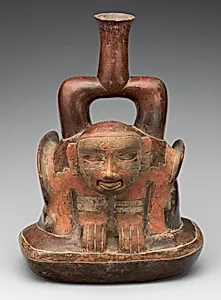
Stirrup-spout vessel with figure in a shell
1200–800 BCE
Medium
Ceramic, slip, post-fire paint
Dimensions
H. 10 5/8 x W. 7 1/2 x D. 8 1/4 in. (27 x 19.1 x 21 cm)
Classification
Ceramics-Containers
Culture
Cupisnique
Department
Arts of Africa, Oceania, and the Americas
Museum
Metropolitan Museum of Art, New York, NY
Credit
Harris Brisbane Dick and Fletcher Funds, 1967
Accession Number
67.239.5
Rights
Public Domain
Art Historical Context
This exquisite stirrup-spout vessel, crafted by Cupisnique artists around 1200–800 BCE, hails from the ancient Cupisnique culture of Peru's northern coast. As one of the earliest known ceramic traditions in the region, it bridges the influential Chavín horizon and later Moche styles, showcasing the Cupisnique's mastery of form and symbolism during a formative era of Andean pre-Columbian art. The vessel distinctive stirrup spout—a looped handle connecting two spouts—facilitated controlled pouring of liquids like chicha (corn beer) in rituals, a innovation that became iconic in Peruvian ceramics. Made from ceramic with colorful slip (a clay pigment mixture) and post-fire paint for vibrant, enduring decoration, it measures 10 5/8 inches tall. The central motif, a figure nestled within a shell, evokes marine mythology, hinting at the Cupisnique's coastal worldview where sea creatures symbolized fertility, power, or supernatural beings. Now housed in the Metropolitan Museum of Art's Arts of Africa, Oceania, and the Americas department, this vessel (acquired via the Harris Brisbane Dick and Fletcher Funds in 1967) offers a window into early Andean ingenuity, blending functionality with profound cultural expression.