
Stirrup Spout Vessel with Raised Geometric Scroll Motif
c. 500 BCE
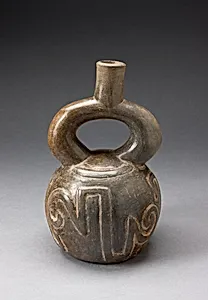
Medium
Ceramic
Dimensions
H.: 14.6 cm (5 3/4 in.)
Classification
earthenware
Department
Arts of the Americas
Museum
Art Institute of Chicago
Accession Number
28176
Rights
Public Domain
Art Historical Context
This exquisite Stirrup Spout Vessel, crafted by artists of the ancient Chavín culture around 500 BCE, stands as a testament to one of Peru's earliest complex societies. Made from earthenware ceramic and measuring just 14.6 cm in height, its distinctive stirrup-shaped spout—formed by bridging two chambers—represents a clever innovation in pre-Columbian pottery. This design prevented spills during pouring, making it ideal for serving sacred liquids like chicha (fermented corn beer) in rituals. The vessel's surface features a raised geometric scroll motif, achieved through skilled modeling and appliqué techniques that add texture and depth. Chavín art, centered around the pilgrimage site of Chavín de Huántar, blended intricate geometric patterns with symbolic power, reflecting the culture's religious worldview and influence across the Andes from 900 to 200 BCE. These motifs may evoke supernatural forces or natural scrolls, underscoring the Chavín's role in unifying diverse regions through shared artistic and spiritual traditions. Housed in the Art Institute of Chicago's Arts of the Americas department, this vessel invites us to marvel at the sophistication of early Andean craftsmanship, where form met function in vessels that bridged the everyday and the divine.