
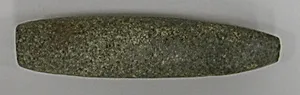
Stone Chisel
Unknown Artist
before 16th century
Medium
Stone
Dimensions
Height 4 in.
Classification
Stone-Implements
Culture
Mexican
Department
Arts of Africa, Oceania, and the Americas
Museum
Metropolitan Museum of Art, New York, NY
Credit
Bequest of Arthur M. Bullowa, 1993
Accession Number
1994.35.411
Rights
Public Domain
Art Historical Context
This compact stone chisel, standing just 4 inches tall, hails from pre-16th century Mexico and exemplifies the practical ingenuity of ancient Mesoamerican craftsmen. Carved entirely from stone, it belongs to the classification of stone implements, tools essential for shaping wood, bone, or other materials in daily life and ritual practices. Now housed in the Metropolitan Museum Art's Department of the Arts of Africa, Oceania, and Americas—thanks to the 1993 bequest of Arthur M. Bullowa offers a tangible link to indigenous technologies before European contact. Dating to the pre-Columbian era, this chisel reflects the sophisticated stone-working skills of Mexican cultures, such as those of the Aztecs, Maya, or their predecessors. Artisans expertly flaked and ground hard stone—likely basalt or obsidian—into a sharp, ergonomic edge, demonstrating precision without metal tools. Such implements were vital for constructing monumental architecture, crafting ceremonial objects, and everyday woodworking. Beyond its utility, the chisel highlights the blurred lines between tool and art in ancient Mexico, where form followed function with remarkable aesthetic restraint. Visitors can appreciate how these unassuming objects underpinned grand civilizations, inviting us to ponder the hands that wielded them centuries ago.