
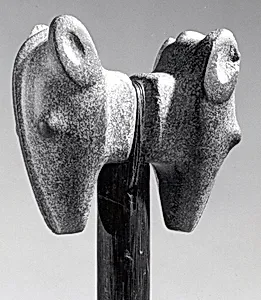
Stone Janus Mace Head
Unknown Artist
11th–16th century
Medium
Stone
Dimensions
H. 3 15/16 x W. 4 3/8 x D. 2 1/8 in. (10 x 11.1 x 5.4 cm)
Classification
Stone-Implements
Culture
Michoacan (?)
Department
Arts of Africa, Oceania, and the Americas
Museum
Metropolitan Museum of Art, New York, NY
Credit
The Michael C. Rockefeller Memorial Collection, Bequest of Nelson A. Rockefeller, 1979
Accession Number
1979.206.764
Rights
Public Domain
Tags
Art Historical Context
Behold the **Stone Janus Mace Head**, striking artifact from the Michoacán region (?) of Mexico, dating to the 11th–16th century. Crafted from stone and measuring just under 4 inches high, this compact yet formidable object was likely the business end of a ceremonial or functional mace—a weapon classified among stone implements in the Metropolitan Museum of Art's Arts of Africa, Oceania and the Americas collection. "Janus" name evokes two-faced Roman god, hinting at dual visages carved into the stone, a motif symbolizing vigilance, duality, or divine protection in pre-Hispanic Mesoamerican cultures. In the vibrant world of Michoacán's ancient societies—possibly linked to the Purépecha people, fierce rivals of the Aztecs—this mace head blends utility with artistry. Stone carving techniques allowed for intricate detailing on such a small scale, transforming a tool of war into a potent cultural emblem. These implements often served ritual purposes, embodying power and the supernatural in battles or ceremonies. Gifted through The Michael C. Rockefeller Memorial Collection in 1979, this piece invites us to ponder the skilled hands behind it: an unknown artist whose work bridges everyday defense and spiritual symbolism. A testament to Mesoamerica's ingenuity, it reminds visitors of the artistry in ancient weaponry.