
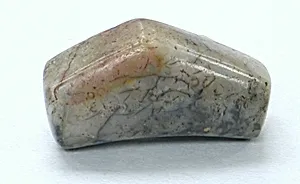
Stone Pulidor
Unknown Artist
before 16th century
Medium
Stone
Dimensions
Length 1-7/8 in.
Classification
Stone-Implements
Culture
Mexican
Department
Arts of Africa, Oceania, and the Americas
Museum
Metropolitan Museum of Art, New York, NY
Credit
Bequest of Arthur M. Bullowa, 1993
Accession Number
1994.35.296
Rights
Public Domain
Art Historical Context
Nestled in the Metropolitan Museum of Art's Department of Arts of Africa, Oceania, and the Americas, this **Stone Pulidor** hails from ancient Mexican culture, crafted before the 16th century. Measuring just 1-7/8 inches in length, this unassuming stone tool exemplifies the ingenuity of pre-Columbian artisans. Bequeathed by Arthur M. Bullowa in 1993, it offers a tangible link to the everyday technologies of Mesoamerican societies. As a **stone implement**, the pulidor—meaning "polisher" in Spanish—was essential for smoothing and refining surfaces on ceramics, jade, or other materials. Its compact, ergonomic form suggests skilled stoneworking techniques, likely involving careful selection of durable stone and precise shaping through abrasion. Such tools were vital in workshops where artisans produced intricate pottery and ornaments, highlighting the practical artistry that underpinned Mexico's vibrant cultural traditions. Though created by an unknown artist, this pulidor reveals the sophisticated craftsmanship of indigenous Mexicans long before European contact. It invites us to ponder the hands that wielded it, transforming raw materials into objects of beauty and utility in daily life. A quiet testament to enduring innovation!