
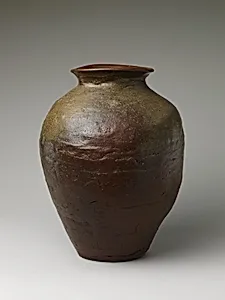
Storage Jar
Unknown Artist
14th–15th century
Medium
Stoneware with natural ash glaze (Tanba ware)
Dimensions
H. 16 7/8 in. (42.9 cm); Diam. 12 1/2 in. (31.8 cm)
Classification
Ceramics
Culture & Period
Japan · Muromachi period (1392–1573)
Department
Asian Art
Museum
Metropolitan Museum of Art, New York, NY
Credit
The Harry G. C. Packard Collection of Asian Art, Gift of Harry G. C. Packard, and Purchase, Fletcher, Rogers, Harris Brisbane Dick, and Louis V. Bell Funds, Joseph Pulitzer Bequest, and The Annenberg Fund Inc. Gift, 1975
Accession Number
1975.268.427
Rights
Public Domain
Art Historical Context
This unassuming yet striking Storage Jar, crafted by an unknown artist in Japan's Tanba region during the 14th15th century Muromachi period (1392–1573), the rustic beauty of everyday ceramics elevated to art. Standing at 16⅞ inches tall with a 12½-inch diameter, it's made of durable stoneware coated in a natural ash glaze—a hallmark of Tanba ware one of Japan's ancient kilns. The glaze, formed spontaneously from wood ash in the kiln's high heat, creates earthy, mottled tones of brown, green, and subtle iridescence, embracing imperfection in a precursor to the wabi-sabi aesthetic. In the Muromachi era, amid Zen Buddhism's influence and the shogunate's cultural patronage, such jars served practical purposes: storing rice, tea, or sake in homes and temples. Tanba potters fired these vessels in dragon kilns on wooded hillsides, harnessing nature's alchemy for glazing without added pigments. This technique not only ensured functionality but also imbued the ware with organic vitality, reflecting Japan's reverence for humble, enduring objects. Today, housed in the Metropolitan Museum of Art's Asian Art Department as part of The Harry G. C. Packard Collection (1975), this jar invites us to appreciate the artistry in utility— a quiet testament to medieval Japan's harmonious blend of craft, nature, and daily life.