
1350
Medium
lithography
Dimensions
244; 293; 418; 196
Rights
Public Domain
About this artwork
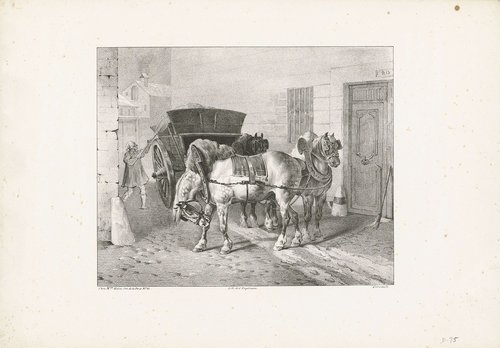
Een man schept de vuilnis in zijn wagen. Voor de wagen zijn drie trekpaarden gespannen.
Art Historical Context
**Théodore Géricault *1350* (1823 Created in 1823, just a year before his untimely death at age 32 *1350* is a lithography by French Romantic artist Théodore Gault. Measuring a modest 196 × 244 mm, this captures a gritty urban scene: a laborer shoveling refuse into a cart pulled by three sturdy draft horses. Géricault, renowned for masterpieces like *The Raft of the Med* (1819), turned to lithography in his final years, producing over 30 prints that explored everyday life with raw realism. Lithography, a revolutionary 19th-century technique using greasy crayon on stone for crisp reproductions, allowed Géricault to disseminate his work widely and experiment with bold contrasts and dynamic compositions. Here, his fascination with horses—evident in his equine studies—shines through the powerful, harnessed team, symbolizing the brute strength of the working class amid post-Napoleonic France's social upheavals. This piece highlights Romanticism's embrace of the marginalized, elevating a mundane sanitation task into a poignant commentary on urban toil. A testament to Géricault's versatility, *1350* invites visitors to appreciate the artistry in ordinary struggle.
About the Artist
Théodore Géricault · 1791–1824
Théodore Géricault (1791-1824) stands as one of the most influential pioneers of French Romanticism, despite a career tragically cut short at age thirty-two. Born in Rouen on September 26, 1791, into a wealthy family, Géricault's brief but intense artistic life transformed the trajectory of nineteenth-century European painting. Géricault began his formal training in 1808 under Carle Vernet, maste...