
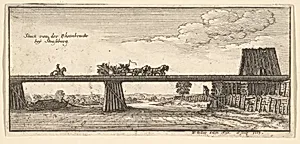
Strasbourg: The Kehl Bridge, from "German Views"
Medium
Etching
Dimensions
Sheet: 2 1/16 × 4 5/16 in. (5.3 × 11 cm)
Classification
Prints
Department
Drawings and Prints
Museum
Metropolitan Museum of Art, New York, NY
Credit
Purchase, Joseph Pulitzer Bequest, 1917
Accession Number
17.50.17-389
Rights
Public Domain
Tags
Art Historical Context
Wenceslaus Hollar's etching *Strasbourg: The Ke Bridge, from "German"* (1665) captures a lively riverside scene along the Rhine, featuring the prominent Kehl Bridge bustling with horses, boats, carriages. This diminutive print, measuring just over 2 by 4 inches, showcases Hollar's extraordinary skill in rendering intricate details on a tiny scale. As a Bohemian-born artist who spent much of his career in, Hollar was renowned for his topographic views, documenting Europe's architecture and daily life with meticulous precision. Created during a period of European travel and political flux in the mid-17th century, the work reflects Strasbourg's strategic importance as a border city between France and the Holy Roman Empire. The Kehl Bridge, a vital crossing point, symbolizes connectivity and commerce, alive with the tag-along energy of travelers and traders. Hollar's etching technique—using acid to bite fine lines into a metal plate—allowed for subtle textures, from rippling water to the wooden spans of the bridge, making it a portable window into 17th-century infrastructure. Part of Hollar's broader "German Views" series, this piece highlights the rise of printmaking as a democratic art form, enabling widespread dissemination of accurate vistas. Now in the Metropolitan Museum of Art's Drawings and Prints collection, it invites visitors to marvel at how such a small gem preserves a fleeting moment of historical vibrancy.
About the Artist
Wenceslaus Hollar · 1607–1677
Wenceslaus Hollar (1607-1677) was a prolific Bohemian etcher who became one of the most accomplished printmakers of the seventeenth century. Born in Prague, he trained under Matthäus Merian in Frankfurt before entering the service of Thomas Howard, Earl of Arundel, in 1636. Hollar spent most of his career in England, where he produced approximately 2,740 etchings documenting an extraordinary range...