
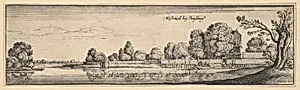
Strasbourg: The Toll House
1625–77
Medium
Etching; first state of two
Dimensions
Sheet: 1 7/8 × 6 1/2 in. (4.7 × 16.5 cm)
Classification
Prints
Department
Drawings and Prints
Museum
Metropolitan Museum of Art, New York, NY
Credit
Gift of Robert Hartshorne, 1918
Accession Number
18.48.1-1
Rights
Public Domain
Tags
Art Historical Context
Wenceslaus Hollar, a masterful Bohemian etcher active in the 17th, captures the bustling riverside life of Strasbourg in *Strasbourg: The Toll*. This intimate etching, dated within Hollar's lifetime (1625–77), depicts a toll house perched along the city's waterways—likely the Ill River—amidst boats and river traffic. Strasbourg, a vibrant trading hub in Alsace on the Franco-German border, was a focal point for commerce and conflict during the Thirty Years' War era, and Hollar's precise topographic views preserve its architectural charm and daily rhythms. Rendered in the first state of two, this rare etching (1 7/8 × 6 5/2 in.) showcases Hollar's etching technique, where acid etches intricate lines into a metal plate for reproduction. His fine, delicate lines excel in conveying texture—from weathered stone to rippling water—making small-scale prints like this accessible yet richly detailed. Hollar produced thousands of such works during his travels across Europe and England, influencing later topographical artists. Today, this gem from the Metropolitan Museum of Art's Drawings and Prints department (gift of Robert Hartshorne, 1918) invites visitors to glimpse 17th-century urban vitality, highlighting etching's role in democratizing art and documenting fleeting cityscapes.
About the Artist
Wenceslaus Hollar · 1607–1677
Wenceslaus Hollar (1607-1677) was a prolific Bohemian etcher who became one of the most accomplished printmakers of the seventeenth century. Born in Prague, he trained under Matthäus Merian in Frankfurt before entering the service of Thomas Howard, Earl of Arundel, in 1636. Hollar spent most of his career in England, where he produced approximately 2,740 etchings documenting an extraordinary range...