
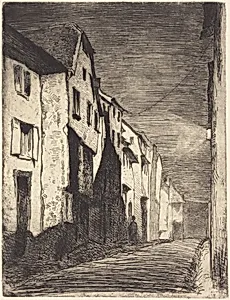
Street at Saverne
Medium
etching on Asian laid paper
Classification
Department
CG-W
Museum
National Gallery of Art, Washington, D.C.
Credit
Rosenwald Collection
Accession Number
1943.3.8405
Rights
Public Domain
Art Historical Context
James McNeill Whistler’s *Street at Saverne* (1858) captures a quiet moment in the French town of Saverne, Alsace, during the artist’s early travels through Europe. At just 24, the American-born painter and printmaker—later renowned for his elegant portraits and tonal harmonies—was honing his skills in Paris and beyond, drawing inspiration from French Realists like Gustave Courbet. This etching reflects his youthful fascination with everyday urban scenes, rendered with a fresh, observational eye amid the mid-19th-century revival of printmaking. Executed as an etching on Asian laid paper, the work showcases Whistler’s masterful use of the medium. Etching allowed him to achieve delicate, fluid lines through acid biting into a metal plate, creating subtle textures and depth. The choice of Asian paper, prized for its soft absorbency, enhanced ink retention and subtle tonal variations—a nod to Whistler’s emerging interest in Japanese aesthetics, which would define his later Aesthetic Movement style. Housed in the National Gallery of Art’s Rosenwald Collection (Department CG-W), this print exemplifies Whistler’s early technical prowess and holds cultural significance as part of his "French Set," bridging Realism and his innovative approach to harmony over narrative. Visitors will appreciate its intimate scale and atmospheric charm, inviting a closer look at 19th-century life through one of art’s great tonal poets.
About the Artist
James McNeill Whistler · 1834–1903
James Abbott McNeill Whistler (1834-1903) was an American-born painter and printmaker who became a leading figure in the Aesthetic Movement and pioneer of Tonalism and Japonisme. He revolutionized art by championing "art for art's sake" and treating paintings as visual equivalents of musical compositions, titling works as "arrangements," "harmonies," and "nocturnes" to emphasize formal qualities o...