
Street scene in the Yoshiwara
ca. 1680
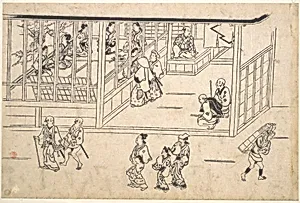
Medium
Monochrome woodblock print; ink on paper
Dimensions
10 1/8 x 15 1/5 in. (25.7 x 38.6 cm)
Classification
Prints
Culture & Period
Japan · Edo period (1615–1868)
Department
Asian Art
Museum
Metropolitan Museum of Art, New York, NY
Credit
Gift of Estate of Samuel Isham, 1914
Accession Number
JP809
Rights
Public Domain
Tags
Art Historical Context
Hishikawa Moronobu *Street Scene in the Yoshiwara*ca. 1680) captures the vibrant energy of Edo-period (1615–1868) Japan's most notorious pleasure district. This monochrome woodblock print, rendered in ink on paper, everyday life along the Yoshiwara's bustling streets, with figures of men and women mingling amid houses and lanterns. Measuring 10 1/8 x 15 1/5 inches, it exemplifies Moronobu's mastery in illustrating the "floating world" (ukiyo-e), a genre celebrating urban pleasures, fashion, and theater. As one of the earliest ukiyo-e pioneers, Moronobu helped popularize affordable woodblock prints for the growing merchant class. His sumizuri-e technique—single-color ink printing—relied on precise carving and bold lines to convey depth, movement, and social interactions. Unlike later multicolored works, this format highlights the artistry in shading and composition, making scenes accessible and intimate. Culturally, the Yoshiwara was Edo's licensed red-light district, a hub of entertainment where courtesans embodied beauty ideals. Moronobu's print offers a window into 17th-century Japanese society, blending realism with stylized grace, and reflects the era's fascination with transient joys amid strict samurai rule. A gift to the Metropolitan Museum of Art in 1914, it remains a treasured glimpse of Japan's artistic golden age.
About the Artist
Hishikawa Moronobu 菱川師宣 (Japanese) · 1618 –1694
Japanese, 1618–1694