
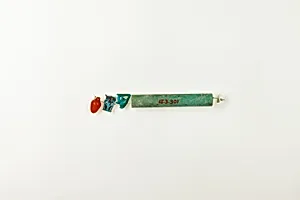
String of 3 amulets and 1 cylindrical bead
Unknown Artist
ca. 1850–1750 B.C.
Medium
Green feldspar, beryl, faience, glazed steatite, and carnelian
Dimensions
15.3.301: 3.6 cm (1 7/16 in.); 15.3.302: 0.7 cm (1/4 in.); 15.3.303: 0.7 cm (1/4 in.); 15.3.304: 0.8 cm (5/16 in.)
Classification
Beads
Period
Middle Kingdom
Department
Egyptian Art
Museum
Metropolitan Museum of Art, New York, NY
Credit
Rogers Fund, 1915
Accession Number
15.3.301–.304
Rights
Public Domain
Art Historical Context
This delicate string of three amu and one cylindrical bead hails from Egypt's Middle Kingdom, dating to around 1850–1750 B.C., during the 12th to early 13th Dynasty. Crafted for personal adornment or ritual use, these tiny treasures—measuring just a few centimeters—exemplify the era's refined jewelry-making, a time when Egypt enjoyed renewed stability and artistic innovation after the First Intermediate Period. The pieces showcase a vibrant array of materials: vibrant green feldspar and beryl for their life-affirming hues, glassy blue-green faience (a molded, glazed ceramic prized for its jewel-like sheen), polished glazed steatite, and fiery carnelian. Egyptians favored these semiprecious stones and crafted composites not just for beauty but for their protective qualities—green tones evoked fertility and rebirth, while carnelian's red symbolized vitality and warding off evil. Amulets like these were everyday talismans, strung into necklaces or bracelets to safeguard the wearer in life and the afterlife. Their precise carving and multicolored palette highlight Middle Kingdom artisans' technical mastery, blending functionality with symbolic power. Acquired through the Rogers Fund in 1915, this ensemble invites us to marvel at ancient Egypt's enduring belief in amulets as bridges between the mortal and divine.